Self-expression, simply put, is the way someone represents who they are through the use of art, music, physical appearance, and so forth. When we think of self-expression, we rarely think of someone who goes to work with full sleeves and/or piercings, we instead think of the way a person dresses, acts, etc. So today I bring to you the big question of “Why aren’t tattoos just considered an extension of self-expression?” Some view the human body as an empty canvas that is meant to be filled or not with one’s feelings, opinions, passions, hobbies etc. Ultimately, the choice is up to the “owner” of the body to decide how to represent themselves. So, why aren’t tattoos just considered an extension of self-expression? In order to answer this big question, we must first look into the history and stigma of tattoos and then review the four categories of dress code policies in order to further understand why ink is not considered self-expression and why it SHOULD BE.
The History of Tattoos
According to author Sarah Wuh from Drops of Ink, “Tattoos have come a long way in American culture. They have evolved from a symbol of rebellion to a widely accepted form of self-expression. However, veiled behind this progress, the societal stigma surrounding tattoos in the United States still remains prominent today. To many, a stain on a body is also seen as a stain on one’s character. ” She goes on to tell us the Western culture’s history of tattoos originated in the Polynesian Islands. We learn that tattoos were primarily viewed as “primitive” by European missionaries, but sailors brought this new form of art home to European countries and they soon began to become popular amongst sailors and soldiers in the 1800s. While tattoos are a semi-recent phenomena for the Western cultures, tattoos themselves have been around almost since the beginning of time. Ancient Egyptians and Native Americans are just two examples of this truth. Additionally, tattoos weren’t always just for “self-expression” they were also used to signify a person’s status and/or tribe. The beauty of art is that it is a form of communication that can be understood by all, breaking down the barriers between different groups and languages. So whether it be artistic self-expression OR a form of communication with others, tattoos have been around for centuries.
Tattoos did not make it to the USA until the early 1900s. At this time, circus “freaks”, also known as social outcasts, who traveled the country performing various wild and entertaining shows, also wore tattoos thus creating the beginning of the tattoo stigma. People thought that tattoos were only meant for the social outcasts. Fast forward to the 1970s, 1980s and even the 1990s where rock and roll music was rapidly growing. Band members began displaying tattoos where the stigma of “tattoo=rebellion” became increasingly substantial. While band members were displaying tattoos, the general public also began displaying tattoos further playing into the stigmas surrounding tattoos and being edgy rebellious actions. “Today, according to a Statistica study, as many as 145 million Americans have a tattoo; that represents more than 40% of the country’s population.”

The Stigma of Tattoos
When tattoos entered the United States they were highly frowned upon because of the “idea” that tattoos were only meant to display rebellion. Various religions have also spoken out against tattoos as they are permanent art on the human body, a place they consider important to worship and respect as it is God’s creation and he did not mean for humans to have permanent art on their bodies. Sarah Wuh continues on in her article to tell us that “A 2017 study done by researchers Kristin Broussard and Helen Harton from the University of Northern Iowa revealed that tattooed people are, in fact, viewed as less favorable than those without tattoos….. ‘People tend to internalize stigma,” Broussard explained. “It doesn’t really matter if you have that identity or you have that characteristic like owning a tattoo. If there’s a very strong societal stigma against it, you will internalize it and still believe it.’ Currently there are equal opportunity employment laws for different social groups, but this does not include self-appearance. The debate and solution to breaking down this stigma has yet to be resolved, but while this stigma is still very real today, more and more people are getting ink thus creating a greater acceptance of self-expression.
Company Dress Codes/no ink rule
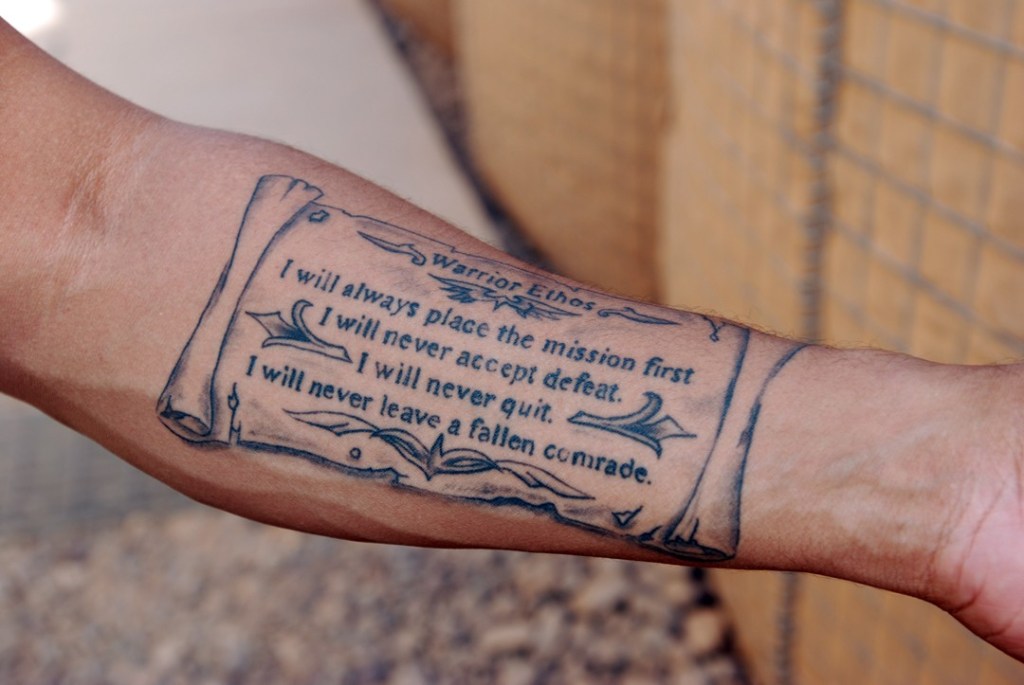
Right now, there are four categories of “dress codes” regarding tattoos. The first is that tattoos are completely acceptable no matter the location, amount or nature of the ink. The second is that the ink must be completely covered in order for a candidate to be considered for a position with the company. The third is that tattoos are acceptable depending on the location, whether they are a “distraction” or not, the amount of ink and the nature of the ink (controversial). This is determined by the employer on a case-by-case basis. There is no set list of what is acceptable/not acceptable (objective) in this category, it is up to the individual employer (subjective) and can raise unfortunate disagreements between tattooed job candidates and employers. The fourth and final category is the least common category to exist, but does still exist today and that is the rule of no tattoos whatsoever. This is the case for certain branches of the United States military.
Why is Self-Expression so Important in Today’s Society
So, in answer to our question of whether or not tattoos are extensions of self-expression, the short answer to this is YES THEY ARE FORMS OF SELF-EXPRESSION. The open-ended question that remains is WHY self-expression isn’t always acceptable in the workplace. All in all, self-expression is very important in today’s society especially because outwardly displaying one’s loves, passions, interests, hobbies, connections etc etc can be a conversation starter between individuals or groups that may not have otherwise happened without the ink. The connections that can be made just from a simple form of self-expression are infinite. If you ask me, that is a pretty darn good reason not to worry about what others think say, or feel and represent yourself how you want to represent yourself. The way you present yourself to others is EVERYTHING. Showcasing yourself as the individual that YOU ARE is more important than conforming to society’s stigmas, biases and prejudices.
In conclusion, GET THE DAMN INK AND BE YOU

If this article resonated with you, was informative in some way or interested you in learning more about self-expression please follow my blog for more posts. Posts go out on Mondays and Saturdays. Thank you for taking the time to read this!
Have a blessed week!
Emma
Works Cited
Wuh, S. (2021, February 12). Tattooed and tabooed: Delving into today’s tattoo stigma. Drops of Ink. Retrieved April 12, 2022, from https://www.lhsdoi.com/21094/features/tattooed-and-tabooed-delving-into-todays-tattoo-stigma/

 The Ultimate Guide to Living a Healthier and More Beautiful Life
I understand the need for self expression. But I also understand a company trying to sell a product or service. If the form of self expression may hurt the “image” of what they are selling then a company should have guidelines. As long as people are aware that how they look may limit career opportunities then it is certainly a choice. I wish it weren’t so but where does a company draw the line? Is any form of self expression acceptable?
LikeLiked by 2 people